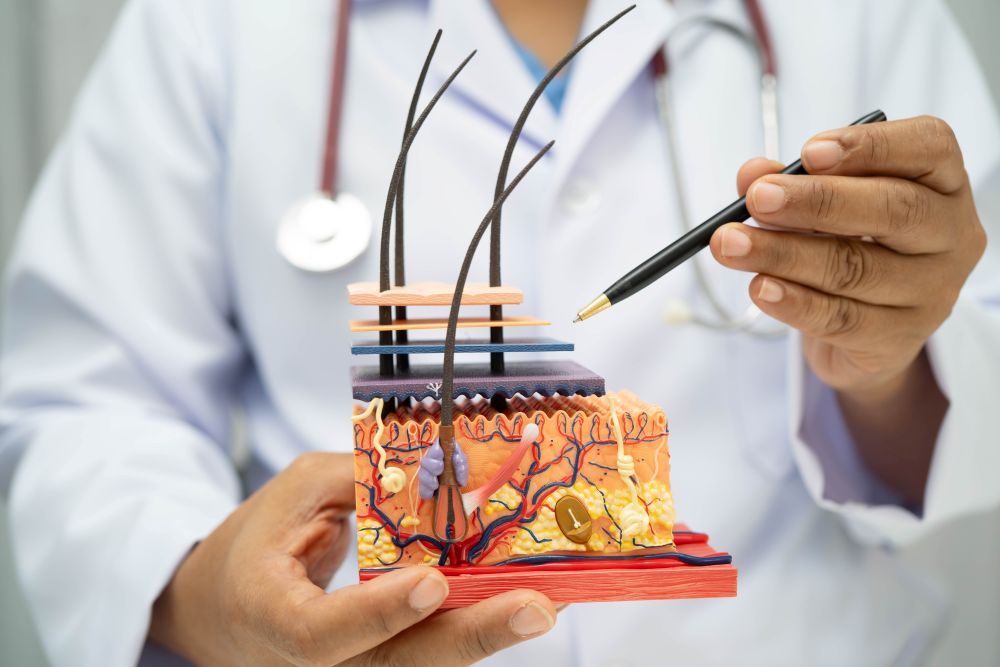
In the age of artificial intelligence and the internet, patients will likely come to their provider with a preconceived idea of what their lesions, rashes, discoloration, ulcers, irritation, or changes in skin texture mean. Providers should be prepared to not only confirm or deny their patients’ assumptions but also explain what the patient is experiencing and help provide next steps. This article intends to parse through the various skin conditions patients could present with.
Initial Evaluation
Providers should be aware of the various ways an alarming dermatologic condition can present itself. A thorough examination and history should be taken, including where on the body the issue is located and what the problem looks like, how it has changed over time, if there is any pain or other associated symptoms, and the patient’s sexual history. Providers should also ask about any new products being used and whether there is presentation elsewhere on the body.
Benign Conditions and Normal Variants
Genital warts may be a common cause for concern in patients presenting with genital dermatologic conditions. As a potential sign of human papillomavirus (HPV), it is important to patients that this is ruled out. However, several benign and noninfectious conditions could be mistaken for genital warts:
- Pearly papules are characterized by rows of small, flesh-colored, dome-shaped papules.
- Fordyce spots can appear as small, yellow-tinged papules that look a bit like pimples and do not cause any symptoms.
- Angiokeratomas are dark red or purple vascular papules resulting from vascular ectasia. They may be prone to bleeding with trauma or may be asymptomatic.
- Epidermoid cysts are slow-growing, skin-colored cysts filled with keratin.
Other conditions include hyperpigmentation, skin tags, vitiligo, and moles.
Most of these require no treatment. However, vitiligo and skin tags may be bothersome to patients and should be treated to improve quality of life at the patient’s request. For moles and hyperpigmentation, it may be beneficial to perform a biopsy to rule out cancer.
Inflammatory Conditions
Inflammation may be mistaken for sexually transmitted infections (STIs) and can cause pain or discomfort. Therefore, it is imperative that accurate examination and history-taking occur.
- It is not uncommon for psoriasis to affect the genitals, but it may lack the scaliness that is seen elsewhere on the body. It may be itchy, painful, moist, and peeling. If the patient has a history of psoriasis, then this may be more likely.
- Balanitis is an acute inflammatory condition of the glans penis and is more common in uncircumcised men and those who are prone to fungal infections. Balanitis commonly affects those with poor hygiene and can present with a white, curdy substance.
- Contact dermatitis and urticaria can look red, raised, and can be itchy. It is important to ask about any soaps, lubricants, or other products used in the genital area. Providers should request that patients switch products to a hypoallergenic or fragrance-free option. Contact dermatitis and urticaria may also be the result of friction.
- Fixed drug eruption is a rash that appears in the same spot at every occurrence with repeated drug use. This rash can look deep red to purple and can present with burning pain. Providers should consider any new oral medications that may have caused the breakout.
- Lichen sclerosis (LS) is a chronic skin disease that causes scarring and inflammation. It can lead to physical changes of the genitalia, including ulceration, phimosis, and scar tissue affecting urinary and sexual function. LS may also present as white plaques.
Other conditions may include seborrheic dermatitis and hidradenitis suppurativa.
Infectious Conditions
- HPV can present as genital warts or dysplasia, and the majority look like pink to gray-white cauliflower-like lesions. Atypical lesions, including those that are pigmented, indurated, ulcerated, bleeding, or unresponsive to standard therapy, may warrant biopsy.
- Herpes simplex virus (HSV) classically presents with grouped vesicles that progress to painful erosions or ulcers, although presentation can vary. When lesions are present, diagnosis should be confirmed with nucleic acid amplification testing (NAAT), such as PCR. Treatment of HSV should be recommended on a case-by-case basis, and patients should be made aware that treatment does not necessarily prevent spread.
- Molluscum contagiosum is characterized by small, typically umbilicated papules that can resemble warts or benign lesions. These are spread through skin-to-skin contact and caused by poxviruses.
Other conditions may include syphilis, infectious balanitis, scabies, and crab lice.
Don't Miss: Premalignant and Malignant Lesions
When treating patients with dermatologic conditions, be sure to watch out for red flags associated with malignancy. These can include:
- Persistent or nonhealing lesions
- Ulceration
- Unexplained bleeding
- New or changing pigmentation
- Growth or progressive change
- Failure to respond to appropriate treatment
An uncertain or suspicious lesion may require biopsy and dermatology or urology referral.
Key Takeaways
- Benign and inflammatory conditions can mimic STIs
- A patient’s history, how the lesions look, and location can help narrow down the diagnosis.
- Persistent, atypical, changing, and treatment-resistant lesions could be a sign of malignancy. It is important to perform a biopsy or refer the patient to a dermatologist or urologist if this is evident.
Resources
Fistarol, S. K., & Itin, P. H. (2013, February). Diagnosis and treatment of lichen sclerosus: an update. American Journal of Clinical Dermatology; PubMed Central. https://doi.org/10.1007/s40257-012-0006-4
Gabrielson, A. T., Le, T. V., Fontenot, C., Usta, M., & Hellstrom, W. J. G. (2019). Male Genital Dermatology: A Primer for the Sexual Medicine Physician. Sexual Medicine Reviews, 7(1), 71–83. https://doi.org/10.1016/j.sxmr.2018.09.004
You may also be interested in...
SMSNA
Choosing the Right Options for Post-Pelvic Surgery Management and Rehabilitation
June 29, 2026Did You Know?
I have Vulvar Cancer, Now What?
May 26, 2026Blog
A Look into Rough Sex – Interests and Concerns
February 3, 2026Blog
How to Care for Your Cervix
January 13, 2026SMSNA Patients
Spanish Tinder Habits by Gender, Age, and Sexual Orientation
December 16, 2025SMSNA Patients
How Often Are Dating Apps Used for Casual Sex? New Study Explains Key Factors
October 15, 2024Did You Know?
What Is a Colposcopy, and What Should I Expect?
May 28, 2024Blog
What Actually Are Cold Sores? Facts, Symptoms, and Treatments
June 4, 2024Other Popular Articles

What Is the Average Penis Size?
If you have ever wondered how your penis compares to others in terms of size, you are not alone. Many men are curious to know how their penises stack up compared to the average. Unfortunately, general curiosity can sometimes give way to full-on obsession and anxiety about penis size. This can be an unhealthy and often unnecessary fixation, especially because most men who think their penises are too small have perfectly normal-sized penises.

Can Sex Reduce Menstrual Cramps?
The SMSNA periodically receives and publishes ‘guest editorials.’ The current article was submitted by Mia Barnes, a freelance writer and researcher who specializes in women's health, wellness, and healthy living. She is the Founder and Editor-in-Chief of Body+Mind Magazine.
Having sex while you experience menstrual cramps is healthy and can provide significant benefits. While it might not be the first activity that comes to mind when your PMS or period cramping begins, many people enjoy sex to reduce menstrual cramps, experience increased pleasure and benefit from other advantages. Learn more about having sex while menstrual cramps are happening and how it can help your body.

What Is Sensate Focus and How Does It Work?
Sensate focus is a technique used to improve intimacy and communication between partners around sex, reduce sexual performance anxiety, and shift away from ingrained, goal-oriented sexual patterns that may not be serving a couple.

What Is Jelqing, and Does It Actually Work?
The term “jelqing” refers to a set of penis stretching exercises that some believe can make the penis bigger. Although the practice has gained attention and popularity in blogs and internet forums in recent years, there is no scientific evidence that it is an effective way to permanently increase the size of one’s penis. In fact, in some cases, jelqing may actually cause damage to the penis, so it is a good idea to get all the facts before setting off to try it.

How Long Does It Take the Average Man to Ejaculate?
On average, it takes a man between 5 to 7 minutes to orgasm and ejaculate during sexual intercourse.
Can Sex Throw off Your Vaginal pH Balance?
The SMSNA periodically receives and publishes ‘guest editorials.’ The current article was submitted by Mia Barnes, a freelance writer and researcher who specializes in women's health, wellness, and healthy living. She is the Founder and Editor-in-Chief of Body+Mind Magazine.
Your vagina is a pretty powerful organ. It is a pathway for menstrual blood and babies. It also is a main player in sexual intercourse. You might hear about your vagina’s pH and worry that yours is at risk. Here’s what to know about vaginal pH, including the impacts sex could have.
Attention: Restrictions on use of SMSNA content in third party applications, including artificial intelligence technologies, such as large language models and generative AI.
You are prohibited from using or uploading content you accessed through this website into external applications, bots, software, or websites, including those using artificial intelligence technologies and infrastructure, including deep learning, machine learning and large language models and generative AI.
Subscribe for our Newsletter!