Manage Peyronie's Disease Beyond Improving Curvature: Insights from the 27th SMSNA Annual Meeting
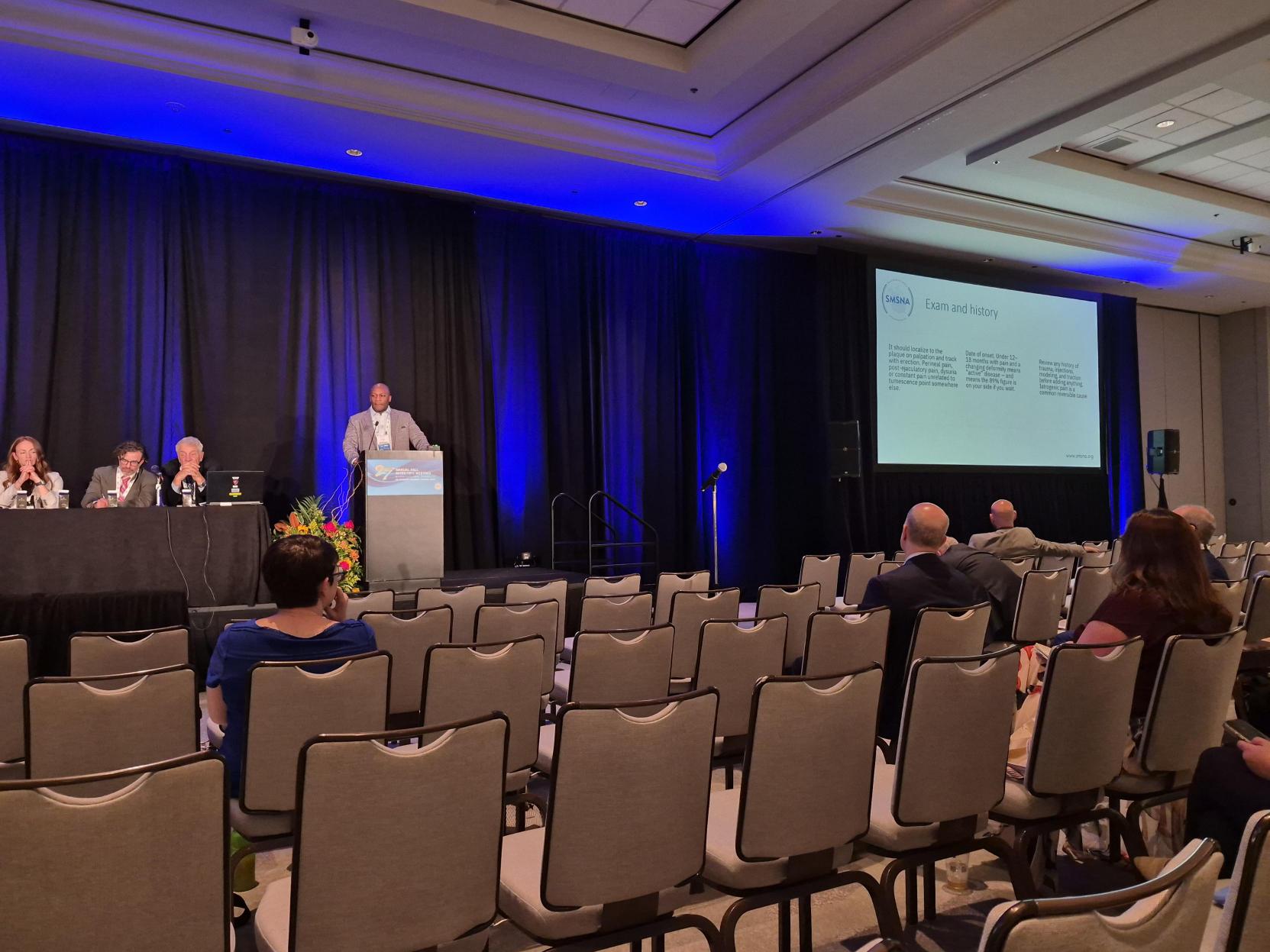
On Friday, October 9, at the 27th Annual SMSNA Fall Scientific Meeting, Drs. Raevti Bole, Lawrence Jenkins, and Matthew Ziegelmann discussed the management of penile shortening, pain, and indentation deformity in Peyronie's disease (PD).
Dr. Ziegelmann presented a case study of a 54-year-old patient with PD who experienced penile shortening. He explained that many patients report dissatisfaction with their penile length, sexual performance, and self-image. One of the most challenging yet important aspects of PD treatment is patient counseling, particularly helping men understand that their penis may not return to its original length. Although several oral therapies are available, oral monotherapy is generally not recommended for treating PD deformity. However, pentoxifylline may be used off-label to address fibrosis, while tadalafil is commonly used to treat PD-related erectile dysfunction (ED). Nonsurgical options also include penile traction therapy and vacuum erection devices, although improvements in length may not meet patient expectations. Injections have not been proven to restore penile length, and surgery is not generally the preferred approach for shortening alone. For his patient, Dr. Ziegelmann recommended tadalafil, traction therapy, and realistic expectations about treatment outcomes.
Dr. Jenkins presented a case involving pain during erections or penetration. He explained that pain may resolve as PD progresses beyond its active phase, although penile curvature may persist. He recommended first identifying the location of the pain and plaque, along with reviewing the patient's history of injections, traction therapy, or other treatments. Several treatment options are available, although not all are supported by sufficient evidence or FDA approval. Dr. Jenkins noted that pain persisting beyond the inflammatory phase of PD may indicate another underlying condition. He also emphasized the importance of early intervention for pain, as surgery is generally considered once the disease has stabilized and curvature is no longer changing. In his patient's case, addressing the pain within the first year may have been beneficial.
Dr. Bole discussed a patient with penile deformity resulting in loss of girth and length. She explained that volume loss and indentation deformities are common concerns in PD and may reduce sexual activity independently of penile curvature. Hinge deformities, which can cause instability during penetration, are particularly challenging. Dr. Bole recommended assessing erectile function and using structured questions to better understand how the deformity affects the patient. Although traction therapy may provide benefits, it may not be sufficient on its own. For her patient, plication alone was unlikely to adequately address the deformity. Dr. Bole reviewed several surgical grafting techniques and emphasized that treatment selection should account for erectile function and other health conditions. Patients with ED that does not respond to treatment may require a different surgical approach. In her case study, the surgical team used grafting to address the deformity and instability of the tunica albuginea, with appropriate patient counseling about expected outcomes.
You may also be interested in...
Other Popular Articles

What Is the Average Penis Size?
If you have ever wondered how your penis compares to others in terms of size, you are not alone. Many men are curious to know how their penises stack up compared to the average. Unfortunately, general curiosity can sometimes give way to full-on obsession and anxiety about penis size. This can be an unhealthy and often unnecessary fixation, especially because most men who think their penises are too small have perfectly normal-sized penises.

Can Sex Reduce Menstrual Cramps?
The SMSNA periodically receives and publishes ‘guest editorials.’ The current article was submitted by Mia Barnes, a freelance writer and researcher who specializes in women's health, wellness, and healthy living. She is the Founder and Editor-in-Chief of Body+Mind Magazine.
Having sex while you experience menstrual cramps is healthy and can provide significant benefits. While it might not be the first activity that comes to mind when your PMS or period cramping begins, many people enjoy sex to reduce menstrual cramps, experience increased pleasure and benefit from other advantages. Learn more about having sex while menstrual cramps are happening and how it can help your body.

What Is Sensate Focus and How Does It Work?
Sensate focus is a technique used to improve intimacy and communication between partners around sex, reduce sexual performance anxiety, and shift away from ingrained, goal-oriented sexual patterns that may not be serving a couple.

What Is Jelqing, and Does It Actually Work?
The term “jelqing” refers to a set of penis stretching exercises that some believe can make the penis bigger. Although the practice has gained attention and popularity in blogs and internet forums in recent years, there is no scientific evidence that it is an effective way to permanently increase the size of one’s penis. In fact, in some cases, jelqing may actually cause damage to the penis, so it is a good idea to get all the facts before setting off to try it.

How Long Does It Take the Average Man to Ejaculate?
On average, it takes a man between 5 to 7 minutes to orgasm and ejaculate during sexual intercourse.

Can Sex Throw off Your Vaginal pH Balance?
The SMSNA periodically receives and publishes ‘guest editorials.’ The current article was submitted by Mia Barnes, a freelance writer and researcher who specializes in women's health, wellness, and healthy living. She is the Founder and Editor-in-Chief of Body+Mind Magazine.
Your vagina is a pretty powerful organ. It is a pathway for menstrual blood and babies. It also is a main player in sexual intercourse. You might hear about your vagina’s pH and worry that yours is at risk. Here’s what to know about vaginal pH, including the impacts sex could have.
Attention: Restrictions on use of SMSNA content in third party applications, including artificial intelligence technologies, such as large language models and generative AI.
You are prohibited from using or uploading content you accessed through this website into external applications, bots, software, or websites, including those using artificial intelligence technologies and infrastructure, including deep learning, machine learning and large language models and generative AI.
Subscribe for our Newsletter!